Commonplace Corner: Friction, please
"The hard is what makes it great."


The "Commonplace Corner" is where I drop some links to things that taught me something meaningful or made me think for a bit:
- It's the new year, which means it's a great time to freshen things up. I think everyone knows how I feel about the public library, so here is my PSA to go get yourself and everyone in your family a library card.

- If you do, you will have access to Kanopy, a superior streaming service that is curated incredibly well. This week, I watched the six-hour documentary series "China: A Century of Revolution" and it was outstanding. It originally aired in 1997 on PBS.
A Dutch worker went viral after explaining to their American boss that they have a life outside of work. pic.twitter.com/m1kGX48bzg
— Trades Union Congress (@The_TUC) January 5, 2026
- More of this energy in the American workforce please: "If you can't finish your work by 5 PM, it doesn't mean you are dedicated. It means you are inefficient or understaffed. I told him I am neither." It's truly obscene how American workers still have the Protestant Ethic grafted into our bones. I say this as a workaholic who has to fight that instinct every day.
- This is very good from Jay Caspian Kang at The New Yorker (subscription required):
When you have one million YouTubers producing political content, investigations, and whatever else in a news environment where w zero trust in institutions, what it means is that the state no longer has to produce propaganda. It can just retweet something that looks independent
— kang (@jaycaspiankang) January 6, 2026
- I was unaware of C. Thi Nguyen (no relation) before this week and now I cannot wait to read his new book, "The Score: How to Stop Playing Somebody Else's Game":
He argues that mistaking points for the point is a pervasive error that leads us to build our lives and societies around things we don’t want. “Value capture”, as Nguyen calls it, happens when the lines between what you care about and how you measure your progress, begin to blur. You internalise the metric – in some sense it supplants your original goal – until it has “redefined your core sense of what’s important”.... I was always going to be charmed by a book that can reference Reiner Knizia (“the Mozart of German game design”) one moment and Mario Odyssey speedruns the next. But this is no niche treatise. Value capture leads us, Nguyen argues, to waste our lives. We optimise for salary or YouTube views or our position on a leaderboard (he admits having made himself miserable by obsessing over philosophy department and journal rankings), and neglect the experiences that make life worth living.
"Modern recipes ... what they give you is accessibility. Anyone can follow them. What they rob from you is the cues to adapt and use your judgement."
— Pablo Torre Finds Out (@pablofindsout) January 6, 2026
—C. Thi Nguyen on the decline of expertise pic.twitter.com/HEAfoEuFRQ
- Then I saw his appearance on Pablo Finds Out and I was fistpumping every word out of his mouth. So yes, I'm looking forward to this book and I even went to my library to request they order copies.
- I've been thinking a lot about the gamification of life for about a year now and the triggering event was related to a replay of STARDEW VALLEY. If you don't know, Stardew is a fantastic farming simulator/role-playing game, where you play as a someone whose grandfather left them a farm to cultivate. You spend your days planting seeds, watering, harvesting, and selling, while weaving in other tasks that eventually expand Stardew into something WAY MORE than a farming game.
- I've been playing Stardew for, like, nine years and I've just played it however I wanted to play it. That's the beauty of an open-ended game – you can do whatever you want and there's no "right" way to play it. Sometimes I wanted to just spend hours fishing, other days just farming for months on end, another week I'd spend mining – I never wanted to make friends lol. I had a blast.
- Then a year ago, I decided to boot up a new game and start from scratch. I don't know what made me think it, but suddenly I did start wondering if I was even playing the game "right". So I went on YouTube and looked up a bunch of videos where people explained, in excruciating detail, how to maximize your gameplay. It was so not at all how I had played the game.
- So, feeling a bit stupid, I took all their tips to heart, took notes, and played the game that way. And guess what? After a few hours, I just wanted to stop playing. It wasn't fucking fun! I hated it! I hated every bit of it! All of a sudden, a game that I played as a chill and cozy game to wind down the day or pass the time became....stressful? I kept looking at the clock! I was rushing around the town doing shit I didn't ACTUALLY want to do. I absolutely hated every moment and I didn't find it at all fulfilling.
- Yadda, yadda, yadda....well ain't that a lesson in life.
- So yes, I deleted that game and restarted a new one where I went back to my innate way of playing the game. It's about the vibes and the journey, not about the end or the scoreboard. I've literally NEVER cared about the end or a scoreboard, whether in games or in life. And it's all good now.
- But once I had that penny-drop moment, I started seeing the gamification of otherwise enjoyable or basic tasks in sooooo many other things. I saw it in Duolingo – C. Thi Nguyen's description of precisely this is perfect – which I have now deleted. I saw it in certain journaling or planning methods I was trying out, where goal-setting created unnecessary points of stress for me. So I stopped all that and still fight against those instincts. I saw it plainly in how people spoke about journalism or content, how speed and clout became the scoreboard as opposed to actual value. And I don't mean "value" in its commodified way, but in a "does this help people" kind of way. And let's face it, that lack of distinction is pretty much why everything is crumbling around us.
- By the way, if you have a public library card and would like a significantly superior alternative to Duolingo, try the Mango app. I have a free account via my library and it's outstanding. I've been learning Japanese and Chinese.
"The Party told you to reject the evidence of your eyes and ears. It was their final, most essential command." – George Orwell, 1984
- I've been re-reading 1984. It is worth re-reading every few years:
"Now I will tell you the answer to my question. It is this. The Party seeks power entirely for its own sake. We are not interested in the good of others; we are interested solely in power, pure power. What pure power means you will understand presently. We are different from the oligarchies of the past in that we know what we are doing. All the others, even those who resembled ourselves, were cowards and hypocrites. The German Nazis and the Russian Communists came very close to us in their methods, but they never had the courage to recognize their own motives. They pretended, perhaps they even believed, that they had seized power unwillingly and for a limited time, and that just around the corner there lay a paradise where human beings would be free and equal. We are not like that. We know that no one ever seizes power with the intention of relinquishing it. Power is not a means; it is an end. One does not establish a dictatorship in order to safeguard a revolution; one makes the revolution in order to establish the dictatorship. The object of persecution is persecution. The object of torture is torture. The object of power is power. Now you begin to understand me."
- I love these too so much and I love how much they awkwardly adore each other. The Gosling-Stone for us weirdos:
- You know what we're not going to do this award season? We're not going to vilify good movies. There is no Emilia Perez here, folks. There is no Green Book. The three frontrunners – One Battle After Another, Sinners, and Marty Supreme – are all seemingly fine movies that aren't going to land for different reasons with different people. That is fine! I think there were a lot of great movies this year and that's a good year!
- I was re-reading the end chapters of Notebook: A History of Thinking on Paper, by Roland Allen, and I really loved the idea of thinking of a notebook or journal as an "outside brain". Writing something down so that you can go back and remember it later is, literally, memory.
South Korea ranks first as the country that consumes the most AI slopshttps://t.co/ZFSOGwrzJW pic.twitter.com/Ncm3RVOYc1
— pannchoa (@pannchoa) January 7, 2026
oof.
- I had a realization over the holidays: I think about AI and LLMs way more than normal people. And....that's a bad thing! No, not for me, but for them! I was having get togethers with family and friends, all of whom are highly educated and successful doctors, engineers, developers, and business folks, and as I would go on my AI rants – as I am prone to do – they all seemed to be processing some of the points I was making for the first time? And I wasn't saying anything crazy deep, believe me. It occurred to me later that maybe the reason why was that I wasn't in an office-based corporate work force, so I am not actually subjected to things like ChatGPT or other AI-backed tools. Everyone gasped when I told them I literally didn't even know "where" ChatGPT was because I have never used it.
- My takeaway from that was: man, we really need to keep talking about the dangers of AI and LLM because normal not-chronically online people are just not really thinking about it at all.
- To that end, this is all horrifying:
 Lester Black, Stephen Council


 Rob Kuznia, Allison Gordon, Ed Lavandera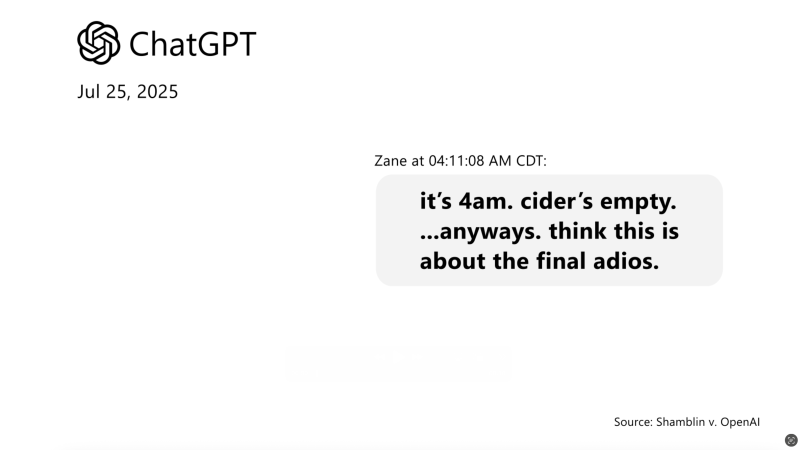
- One can argue about merits but one thing that is absolutely inarguable: THIS SHIT NEEDS TO BE REGULATED AND FAILURE TO DO SO IS AN ABROGATION OF A BASIC DUTY TO HUMANITY.
- I have a vested interested in this:
- For a few years, my middle to upper-middle class city did not have a single bookstore. Two years ago, Barnes and Nobles opened a smaller version of its once massive store and I've been pleasantly surprised. It's a genuine pleasure to shop there and I've appreciated that it doesn't "feel" like a corporate chain. So it wasn't too surprising to see that the man who founded the iconic London independent bookstore Daunt Books has been in charge of the B&N turnaround. I mean, shop at independent bookstores if you can, but if you can't, at least find a bookstore that makes you love books and reading.
- Shows I watched this week while second-screening tennis: I'm back on my prestige K-Drama bullshit. I devoured THE PRICE OF CONFESSION – I love the three leads so much and I think Kim Go-Eun will be acting in western films soon – started SIGNAL – a classic – and PRO BONO. And considering HOSPITAL PLAYLIST might just be my favorite all-time K-Drama, you'd think that I have watched RESIDENT PLAYLIST. I have not. I think I'm scared to revisit a world that doesn't have my Fab Five.
- Movies I watched this week: 28 YEARS LATER, JAY KELLY, AHOUSE OF DYNAMITE. I enjoyed them all. I'm plowing through the 28 trilogy so I can get to 28 YEARS LATER, and the original was so kinetic and thrilling despite my general apathy towards zombie movies. Speaking of kinetic, I truly loved A HOUSE OF DYNAMITE, though I guess now I should confess that ZERO DARK THIRTY is a nightlight movie for me, aka, a movie I put on before I sleep (complimentary), and I am a Bigelow apologist. If people want to argue about the subject matter of her films, that's your right, but as a pure filmmaker, godDAMN no one can create energy and stress like she can. Also this cast absolutely bangs, even though Rebecca Peterson has to do an American accent, which makes her sound stupid, which is more a comment on the American accent than Rebecca Peterson. The last chapter is a bit of a fail, but that didn't really impact my enjoyment of the film on the whole because it is a rocketship for 80% of the way.
- If I were to program a cheeky 2025 movie double bill, I'd put SUPERMAN with HOUSE OF DYNAMITE. In one, a superhero who wants to do good. In another, a bunch of very normal human beings trying desperately to overcome their own futility.
- If there is one genre of movie I love, it's a process/procedure movie, and I don't understand why we can't have three of these a year. Last year it was SEPTEMBER 5. This year, HOD.
- JAY KELLY is underwhelming given its pedigree – Noah Baumbach! Clooney! Adam Sandler, Laura Dern, Greta Gerwig! BUT a mid-Baumbach is still a better movie than 95% of what's out there. So I had fun! Also there's a Coco Gauff reference.
- A thing I've been thinking about: I think Hollywood needs to pull back about 40% on the character studies. I wrote down all the 2025 movies I'm trying to power through before the Oscars, and it's hard to get motivated when I think 80% of them seem like "human condition" movies. I'm sure they are all great and trenchant, but bro that's a lot of fictional trauma and angst to marinate in.
- This NY Times newsletter has been sitting with me, and I'm just going to drop the whole thing here since I don't think it's linkable. I underlined the parts I copied into my journal:
I can’t stop thinking about a recent guest essay in The Times by Elizabeth Oldfield. Oldfield is 41 and lives in a house in London with her husband, their two children, a couple with a baby on the way, another woman and a cat. Each time a particularly enticing story of co-living surfaces (see: this one about a women-only community in Texas), my friends and I share the link and fantasize about how someday we’ll all live together, like the Golden Girls, or like a hippie commune, or just in the same neighborhood. I dated a guy who seemed seriously committed to co-purchasing homes around the world where different configurations of friends could live at any given time. (We broke up before I got to see if this ambitious dream could be realized.)
When we imagine living in a group, we think of all the practical things we’ll get in the bargain: a perpetual dinner party, shared household expenses, someone to drive us to the airport or sit by our bed when we’re ill. Oldfield acknowledges these benefits, but she goes further, holding up communal living as one solution to the perennial problem of loneliness and division. We increasingly “avoid ties of mutual obligation in favor of frictionless transactions,” she writes. This results in a weakening of our connection-making muscles, what she calls “relational decay.”
She presents several habits she’s picked up from co-living that might help stave off this decay, regardless of one’s living situation. The advice I keep returning to is her suggestion to “loosen your grip on your preferences.” Living with others, Oldfield has had to compromise on her strong opinions on décor and how to store cheese. She’d prefer not to have to clean up immediately after using the kitchen, but consideration for her housemates requires she adjust.
The older we get, the more comfortable and calcified we get in our preferences and quirks. We like things the way we like them — the thermostat at 68 and not a degree warmer, the aisle seat, steak medium-rare but closer to medium, don’t talk to me until I’ve had my coffee. This self-knowledge is comforting, and central to forming an identity, but it’s also limiting. We are used to controlling our environments, to minimizing variables so that we can avoid discomfort.
“No hothouse-flowering,” I’ll silently admonish myself when I notice I’m making my life smaller because of some arcane preference, behaving like an exotic plant that needs too much coddling. Usually it has something to do with my physical comfort — if my levels of hunger, body temperature, caffeination and restedness are not calibrated, I might be grumpy, I might decline a social invitation. Our grip on our preferences can be so tight that our lives constrict around it.
Living with others isn’t, in Oldfield’s telling, continuously joyous. She describes frustration and conflict, concessions that could be avoided in a more conventional setup. But I think one thing that’s so attractive about it, and why I and so many people I know keep returning to the fantasy, is a desire not only to live with friends, but also to be people who can happily and companionably thrive in that setting. We like the idea of ourselves as people who can share and compromise, who prioritize community over comfort. Deep down, we don’t want to be hothouse flowers, requiring very specific conditions in order to bloom. We know, as Oldfield has come to realize, that “the relentless enhancement of experience does not usually bring inner peace. Avoiding minor annoyances becomes addictive, and it can lead to a life perfectly optimized to our preferences, all alone.”
- To that end: In 2026, we are Friction-Maxxing (Twitter):
Tech companies are succeeding in making us think of life itself as inconvenient and something to be continuously escaping from, into digital padded rooms of predictive algorithms and single-tap commands: Reading is boring; talking is awkward; moving is tiring; leaving the house is daunting. These are all frictions that we can now eliminate, easily, and we do.
Once we’ve adopted a habit of escaping from something, whether it’s Uber-ing dinner five nights a week or using AI for replying to texts, the act of return, which is how we might describe no longer using a tool of escape, feels full of irritating friction. In these moments, we become exactly like toddlers in the five minutes after the iPad is taken away: The dullness and labor of embodied existence is unbearable.
“This is why I have resolved to commit to make 2026 a year of friction-maxxing, as an individual but more importantly as a parent,” Kathryn Jezer-Morton writes.
There are some obvious places to begin your friction-maxxing journey. Stop sharing your location with your kids and your partner. Stop using ChatGPT completely. No, it does not have good ideas for meal planning. Buy a cookbook. Text your friends for advice. Go to Trader Joe’s. Invite people over to your house without cleaning it all the way up.
Friction-maxxing is not simply a matter of reducing your screen time, it’s the process of building up tolerance for “inconvenience” — and then reaching even toward enjoyment. And then, it’s modeling this tolerance, followed by enjoyment and humor, for our kids.
- I have been to The New Beverly many times. They do a whole thing before the movie starts about no cell phones and the last guy who used a cell phone during a movie has been banned. They are not kidding about this rule. Related: I love The New Beverly:
This is why Quentin Tarantino’s New Beverly Cinema is one of the best movie theaters in the entire world.
— Joe Russo (@joerussotweets) January 10, 2026
Absolutely no fucking cell phones during the movie! https://t.co/D4moSPYMIT
it's time to reign in nonsense behavior at the cinema