Petit Choux: Life or death
I write sins, not tragedies.

Internet ephemera from the tennis world and beyond. Have something you want to include? Join the Discord – we have a really nice and active community growing there – or hmu on Bluesky.
If you’re reading this on email for the first few times, just know that the embeds render better if you click through to the post.
Roland Garros 2026: Order of Play | Draws | Live Scores
- Previously on the Bagel: Who’s got that dog in ‘em?
- The heat broke on Sunday – thank GOD – but Roland Chaos continued. Seeds continued to tumble. The young guns kept youngin' and the draws just got opener and opener. Let’s get into it.
3 - Three players under the age of 21 (Joao Fonseca, Jakub Mensik and Rafael Jodar) have reached the Men’s Singles quarter-final at a Grand Slam event for the first time this century. Arrival.#RolandGarros | @rolandgarros @atptour
— OptaAce (@OptaAce) May 31, 2026
- Let’s start with the boys: Three 20-and-unders booked a spot in their first Grand Slam quarterfinals. [11] Andrey Rublev and [15] Casper Ruud are out. Rublev went three hours and 45 minutes with 20-year-old Jakub Mensik before losing 6-3, 7-6(6), 4-6, 2-6, 6-3. That’s right, it was another win-the-first-two-sets kinda loss for the men of the ATP, and I’ll just say it: if y’all can’t get behind best-of-three after this tournament, I don’t know what will ever change your mind.
- As for Casper, the friendly ghost looked gassed – and understandably so – and was knocked out by 19-year-old Joao Fonseca 7-5, 7-6(8), 5-7, 6-2. The kid really did it. He did that rare thing of backing up a win over one of the Big Four. (ATP)
- More kids doing things: Rafael Jodar rallied from 0-2 down to beat Pablo Carreno Busta 4-6, 4-6, 6-1, 6-2, 6-2 to continue his absurd run of form. He’s now 3-0 in five-set matches. That’s….crazy?
 Tumaini Carayol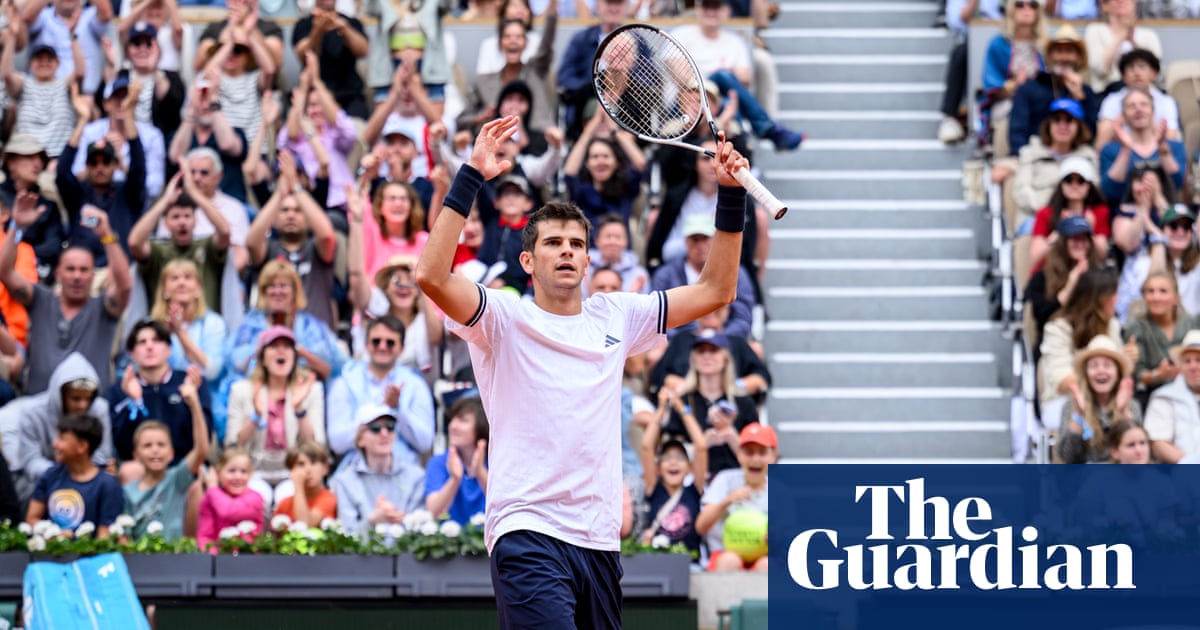
- And so, here are the quarterfinals set for the bottom half of the men’s draw:
[26] Jakub Mensik vs. [28] Joao Fonseca
[27] Rafael Jodar vs. [2] Alexander Zverev
Someone give Viola Davis an Oscar just for this performance of her pretending to take a shot lmaoo 😭 pic.twitter.com/LbP9sia0rQ
— ALUTHEDON (@Mbakaza4L) May 30, 2026
- And now over to the women, and if you’ll allow me, I’m going to get a little existential here.
- What do Mirra Andreeva, Elina Svitolina, Marta Kostyuk, and Sorana Cirstea all have in common? Well, yes, they all won today and are into the Bottom Half quarterfinals. But as I thought about these four today, what came to mind is the way they’ve treated wins and losses throughout their careers. Each one of them is at different points of the same journey: how do you treat each tournament, each match, each point as NOT life or death.
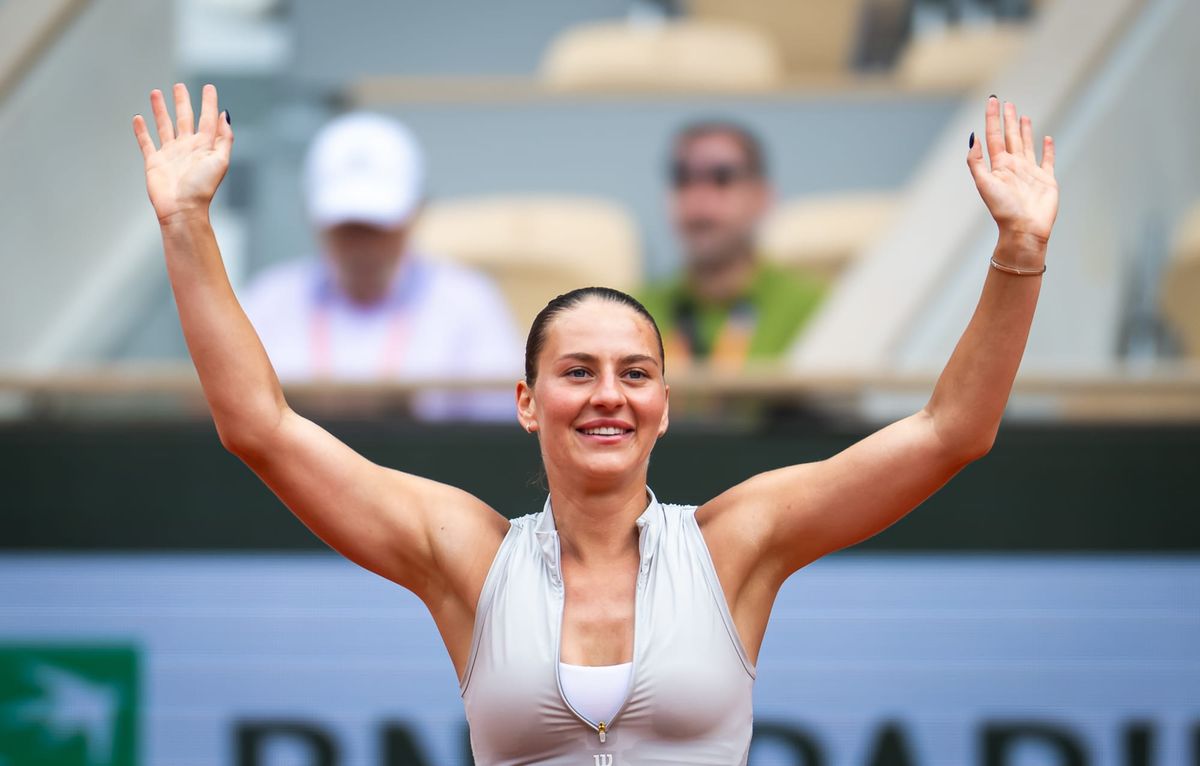
- Let’s focus on the veterans, and yes, despite being just 23 years old – HOW is she two years younger than Iga Swiatek??? – Marta Kostyuk counts as a veteran. Kostyuk, Svitolina, and Cirstea have all walked the path of being desperate – to the point of self-destructive – competitors, yet they’ve booked their spots a Grand Slam quarterfinal with absolute poise, veering on zen.
- Since first interviewing her during her breakout run as a fresh-faced 15-year old at the 2018 Australian Open, I have spent years watching Kostyuk implode on a tennis court. The will to win – the necessity of winning – would cripple her and hold her back. She knew and she couldn’t do much about it. As I wrote after her Madrid win, that desperation was there from the second she picked up a racquet. She got into tennis to try and get her tennis-coach mother’s attention. It was, as she said back then, the only way she could be with her mom, and that’s what she wanted more than anything. If that’s your entree into the sport, that’s gonna play some tricks on your brain. And Marta’s been fighting that part of her brain for years.
Tumaini Carayol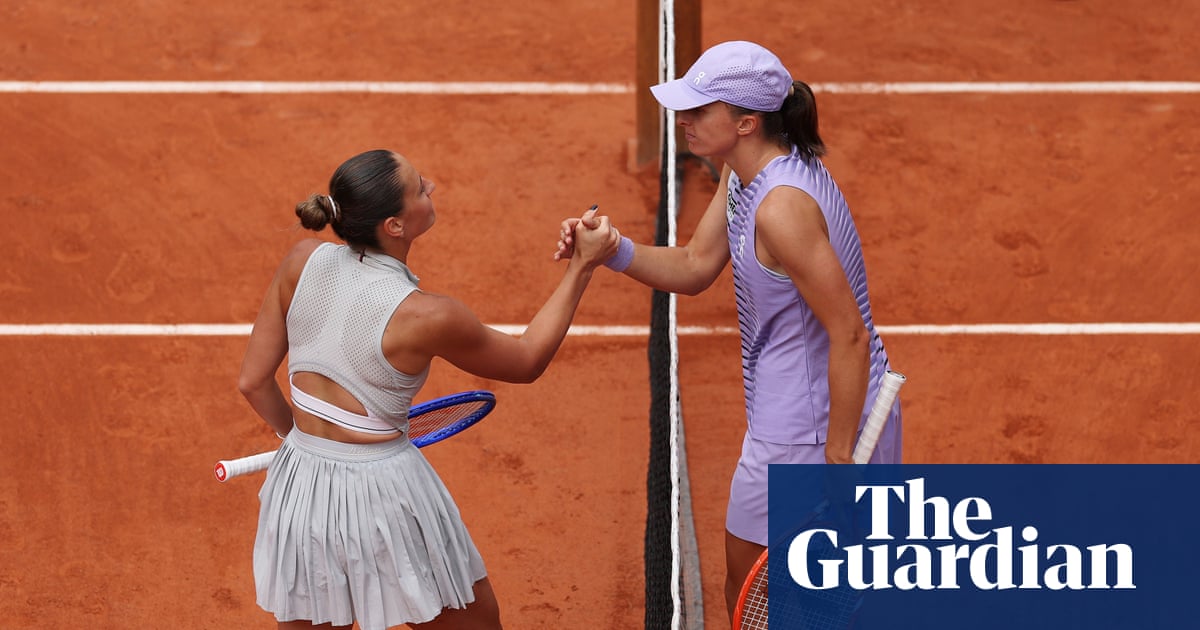
- But here we are. She’s now 16-0 on clay this season, and she dismantled four-time champion Swiatek 6-4, 6-1 to make her first Roland Garros quarterfinal. And if you want to know her mood these days, how much weight she feeling when she’s playing these matches now, just look this: she was dancing during a match against a player she had never won a set off of:
She can dance too💃#RolandGarros pic.twitter.com/Zs16BgSIZ1
— Roland-Garros (@rolandgarros) May 31, 2026
"I would say right now the biggest thing that I do is that nothing is that big, like not one point is that important. There is another one always coming. So I always try to keep that in mind and always try to think about longer perspective on what kind of player do I want to be and where I want to be.
"So, for me, this is the most important thing when I play. So at the end, you can do the right things, but miss the balls or lose the match, but you still did the right things, and this is the priority for me."
- I asked Sorana Cirstea about this after her 6-3, 7-6(4) win over Wang Xiyu. Cirstea is having the best season of her career in what she insists is still her retirement season. She’s into the quarterfinals for the first time since she did it SEVENTEEN YEARS AGO. That’s a whole Moise Kouame ago!
"I think this is the beauty of life. I think the older we get, the more we mature, and we have a different kind of perspective and a different kind of mindset.
"I think when I was really young, it was little bit of life or death every single match. I would win; I was very, very happy. I would lose; two days I would be crying. Which now it's a little bit.
"Yes, I have so much passion for the sport. I have so much joy playing, but in the same time, it's my job. Okay, did I try my best today? Did I bring my 100%? Okay, that's all I can ask.
"Of course, I'm going to be sad if I lose a match, for example, like today, but tomorrow I'm still going to go on court and practice or go to Queen's, the next tournament.
"So I think you have little bit of perspective. Also, I think the biggest change in my career has been, like, from every single year I was mentally a little bit better, and I found my peace. It's just different.
"I mean, some of the athletes manage to get that amazing mentality very early on, and then you see them doing amazing. Some others, they have a roller coaster like I've had. Like I was doing very good, and I've had years where I wasn't playing so good. I was still top 100. I was still very dangerous player, but maybe not at the level that people were expecting for me to go.
"In the same time, I've made peace with everything. I've made peace with my past. I have no regrets for the last couple of years of my career. I gave really my 100%. You can see. Also, I'm here because I worked really hard, and I belong to be here."
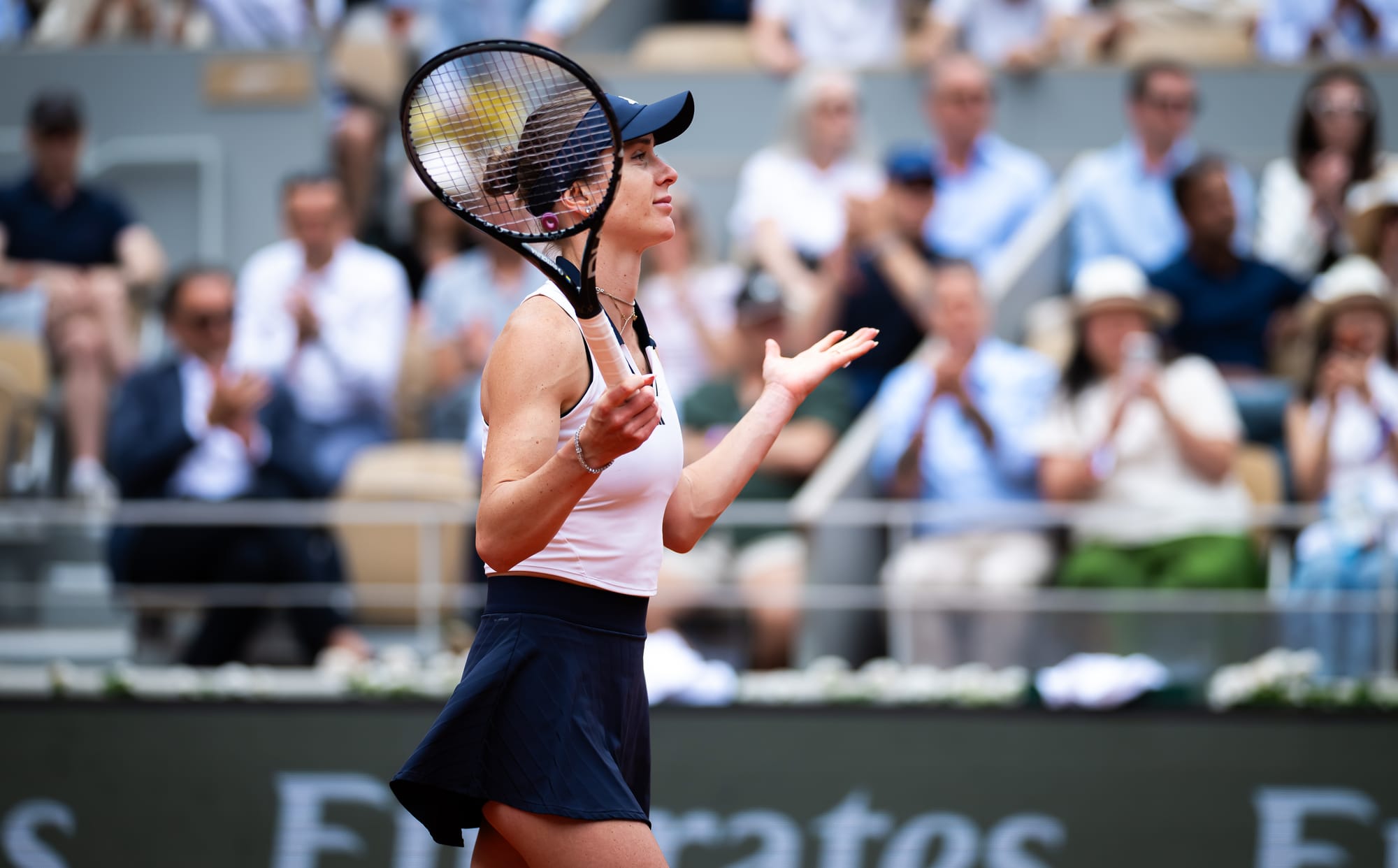
- Elina Svitolina is the most even-keeled of this trio, but she too could be too fiery for her own good, especially before her maternity leave. So I wondered – if that desperation and will to win is a big reason you broke through when you were young, how do you reconcile that with the unhealthy side-effects? How can you harness it in order to maintain your sanity?
"Coming from Ukraine and coming from, you know, also my family kind of was forcing me a lot and pushing me a lot. I think it's like Eastern European mentality to really go through hell kind of to win matches. Everyone is raised differently, but in my case it's been like that.
"I think it's good and bad in the same way, because good is because when you are young, you want to do many things. You want to hang out with your friends. You just want to chill and enjoy your life. For me my mom was really pushing me and really putting me back on track where I had to train a lot and to be focused on my goals.
"But then later, when you are becoming a woman, I think you need to kind of leave that attachment on the side to your parents or to somebody who has been pushing you that much and really be yourself and find your own way that's going to work for you to have this balance.
"For me, it took me years and years to really find it and find my way and beat these kind of demons, in a way. Still beating them every single match that I play (smiling).
"I feel when you're pushing your limits, when you're going through these moments, you are growing and you're learning, and it's the process of that.
"So it's important that it doesn't break you mentally, and that's always been the goal for me, to always stay strong. Okay, you can have bad days, but the life is still good."
- I think it’s remarkable that all three women discussed their “life and death” journeys similarly. It’s about perspective, maturity, and self-awareness. There is no singular answer on the how of it all, but I have to believe that this end-state is the goal.
- Which brings me to Iga Swiatek.
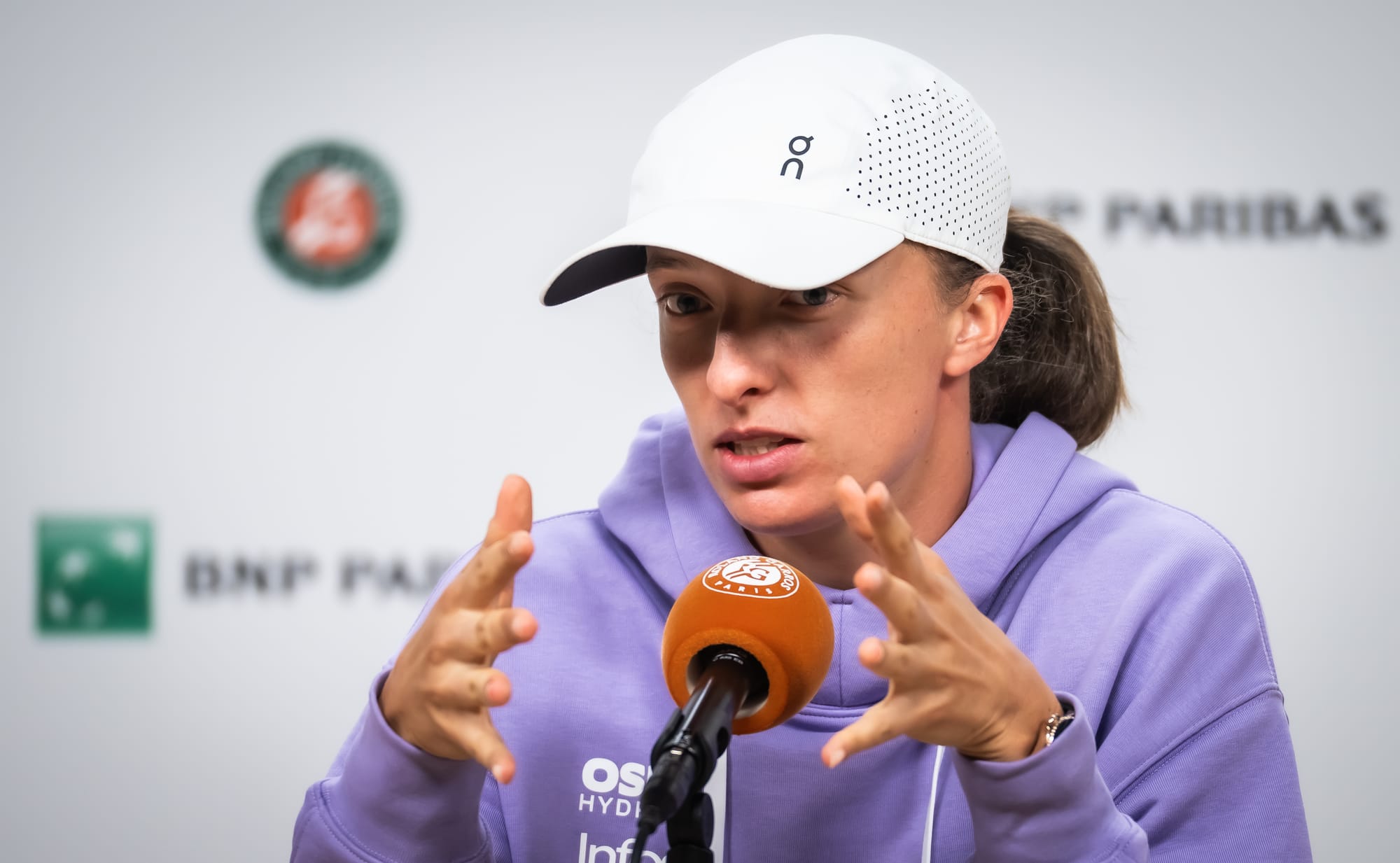
- All credit to Iga. This was a tough loss and she was as open and honest about it as she could be in a room full of strangers. She took it on the chin and, not unlike Coco Gauff the day before, copped to the problematic trends in her current game. Here are some excerpts from her presser:
Q. Tough one today. I feel like tennis players will often talk about how it's easier to stomach a loss as long as you're losing in maybe a different way than you did previously. Since you have clearly been feeling much more comfortable and better in your tennis and the decision-making process, all of that, I wonder if today felt like a familiar loss to you or if it felt like something maybe where you are saying, okay, I can identify still the places where I'm making progress even though I lost today?
IGA SWIATEK: Yeah, well, for sure I lost control of the match, and there was no way for me to come back, because I felt worse and worse. So this is not positive, and this is different than losing to Elina in Rome or to Andreeva in Stuttgart.
So, yeah, it's not great. I know that I lost because I was tense, and my body couldn't really do what my body... the proper things, you know. But it's not the first time, as well. So, yeah, just need to work on it.
Honestly, for me, maybe the toughest loss is when you had the match in your hands, but you made stupid decisions and you let it go and your opponent suddenly comes back. It's also bad when your tennis is just terrible, and you know that you were worse than the players that you play with.
For sure I lost today because Marta used the opportunity, and I was super tense. I feel like I can work on that, at least, and there is a reason, and there is maybe a solution. Maybe it's not going to take one week or one month. Maybe it's going to take even a season or something, but I need to believe that I can work through this and not be thrown off so quickly.
Q. Tough one today. You have achieved so much in your career, you've won so many matches on that court. Can you share why you got so tense today? What's behind it? Like your forehand, for example, why it took you completely out of that game today?
IGA SWIATEK: Well, I mean, we're not on therapy session (smiling), so I'm going to keep it simple, but obviously there could be many reasons. I'd rather work on it on my own.
It is harder a bit to handle stress for me in the last year, especially I feel like the peak was in U.S. this year. So I feel like today I felt off, and I did mistakes that I didn't want to do, and I wanted to play safe, but the ball flew everywhere.
Suddenly these feelings came back, and I tried to work on it with my dialogue inside, but it was tough today. Yeah, so it all kind of went drastically down, and I played worse and worse.
Q. I was curious if your serve was part of that kind of tension? I think from 4-3, you didn't hold serve for the rest of the match, so curious how you felt with that shot. Obviously given the technique change, do you have to, I guess, kind of accept that things might be complicated with that shot until you reach a point where you're comfortable?
IGA SWIATEK: I still don't put the elbow how I exactly want to, so for sure, technically when we have more time to practice, I want to repeat, repeat, repeat a hundred times to get it better.
But, for sure, I think the serve is the most complicated shot. So if something will fall apart a bit under pressure, I feel like it's serve and then movement and then just mis-hitting everything. So, yeah, I guess that happened today.
- That’s pretty candid stuff from Iga, to acknowledge her stress and panic and also the glaring issue with her serve. Maybe saying it out loud will help her start to deal with it head on. These are not overnight fixes and that will be the biggest test of her patience and perspective.
- Yet as Iga got up from the dais and walked out of the room – hat pulled down lower than usual, cozy hoodie looking cozier than usual – one thought lingered in my mind:
Gosh, I really hope she celebrates her birthday.
I really hope people still come up to her and say “Happy Birthday”.
I really hope, despite all this, she has a happy birthday.
- Because perspective’s a bitch. The time you need it most is when things just feel really, really shitty.
- With that, here are the women’s quarterfinals in the bottom half:
[7] Elina Svitolina vs. [15] Marta Kostyuk
[8] Mirra Andreeva vs. [18] Sorana Cirstea
From the tennis legal beat (h/t law 360) pic.twitter.com/9F2cu9DYU0
— Jon Wertheim (@jon_wertheim) May 31, 2026
the wta is trying to get david haggerty off the board.
- Love that The Body Serve Podcast got to experience Roland Garros. They break down their steaming-hot experience here:
- Well folks, it’s happening: The women have the night session on Monday. Aryna Sabalenka and Naomi Osaka will take the stage in the first women’s night match at RG since 2023. (The Athletic via Yahoo)
When organizers looked at the the potential match-ups to put in the featured slot, the only Grand Slam champions to choose from were women: Sabalenka, Osaka and Madison Keys. The only players to reach the pinnacle of the sport and hold the No. 1 ranking were Sabalenka and Osaka.
The move will test Mauresmo’s suggestion that the French audience may not find a women’s match, which is best-of-three sets rather than best-of-five, providing enough value for a single ticket. It also questions how far the tournament’s decision was driven by external circumstances, as opposed to platform Sabalenka and Osaka’s match.
- Is this a win? Eh.
- Look, I’ve been pretty vocal about my belief that this whole night session kerfuffle is a whole lot of nothing. I think a lot of the loudest people on this topic are trying to perform feminism as opposed to actually looking at things that meaningfully affect the women’s game. I don’t care about the night session because, frankly, most of the women of the WTA do not care about the night session. They are perfectly happy playing during the day and not having their sleep schedules all screwed up just because RG decided on this weird Amazon Prime contract and a SINGLE MATCH ticket.

- Regardless of whether men or women play that slot, the concept is flawed at its inception. A men’s match starting at 8:15pm is crazy. That winner is not going asleep before 3am and that is going to impact competitive balance. It’s just a bad idea and I’m fine with the women not being dragged into it.
- Ava Wallace nails it — The women are being set up to fail, and if they succeed that will 100% a credit to them.
Had the French Tennis Federation chosen a men’s match for the night session Monday, at least there would be an argument that it had stuck to its beliefs: the problem is one of quantity, not quality.
Now the FFT has selected Aryna Sabalenka and Naomi Osaka for the honor of playing the first women’s night match since 2023 — after all the male frontrunners have been knocked out, it feels like an act of surrender. Roland Garros views two multiple-time Grand Slam champions as the backup option.
At least Sabalenka and Osaka are equipped to handle the pressure that the rarity of this event inherently creates. When women have such scant chances to prove their matches are “worthy” of a night session match, the FFT can say anything other than a three-set epic proves their point. Until women’s night matches are a regular occurrence, they don’t get the luxury of just letting the match unfold — they have to play good tennis and be brilliant entertainers.
- Some bits and bobbles of tennis (and non-tennis) ephemera:
It was a frantic day, and Madison Keys knows it... 🎙️#RolandGarros pic.twitter.com/5v5VnLog4K
— Roland-Garros (@rolandgarros) May 30, 2026
madison’s delivery kills me.
Pretty excited that these four kids are thriving in Paris#NaomiFelixMadiFoe 🧱🎾🧡 pic.twitter.com/k7e7Jh4hiS
— Jimmy (@Racquetechie) May 31, 2026
 Michaela Makusha
No idea what she said, no idea what I liked on Instagram, no idea that we killed children, no idea I could think of something except a yellow ball.
— Alex Dolgopolov (@TheDolgo) May 30, 2026
Sounds honest, well done👏🏻 https://t.co/9GxPzDzDt9
Amanda Anisimova has a lot of work cut out for her in the second half of the year, because she won so much in 2025. It will be a gauntlet of 4,788 points to defend
— Vansh (@vanshv2k) May 30, 2026
Queens 500 Final
Berlin 500 QF
Wimbledon Final
Canada R4
Cincinnati R3
U.S. Open Final
Beijing 1000🏆
WTA Finals SF
'The Lawn Tennis Association is facing criticism after refusing to grant a wild card into Queen’s to last year’s champion, German star Tatjana Maria', writes @simonrbriggs.
— Telegraph Sport (@TelegraphSport) May 31, 2026
🔗: https://t.co/Ekpgo6XTIH pic.twitter.com/bRzLrZM6qu
Who is responsible for the music at tennis tournaments? 🎶😤
— Tennis Masterr (@tennismasterr) May 30, 2026
I genuinely think DJs and production staff underestimate how much the right song can add to a moment.
Yesterday at 6-5 in the 5th between Fonseca and Djokovic, they had a golden opportunity to set the atmosphere… pic.twitter.com/TqG6J3rP7d
so men are allowed to get naked on court but women can’t change twice off court ??? pic.twitter.com/PtltKJJIiZ
— 🦖 (@RamoFootball) May 30, 2026
 Victor Tangermann
“I know someone sitting out here right now who is saying, ‘What about the use of AI to pioneer breakthroughs in medicine and physics?’… If you’re using it for that purpose, you’re not the problem,” Chieng said. “I’m talking about the accumulation of cognitive debt due to excessive use of large language models… This is why you should be scared of AI.”
“Your generation’s upcoming battle won’t be humans against AI; that’s at least two months away,” he added jokingly. “It’s going to be people with substance versus people with shallow knowledge. It’s going to be mastery versus faking it. It’s going to be people with good taste versus tacky.”
Bop of the Day: Thematic.